


People often use “AI” and “RPA” as if they meant the same thing, because both are described as automation. They are different tools for different jobs. The simplest way to remember it: RPA follows rules you write, while AI works out patterns from data.
The key differences
| RPA | AI (for example generative AI) | |
|---|---|---|
| How it works | Follows explicit, step-by-step rules | Predicts or generates based on patterns learned from data |
| Best with | Structured data and fixed screens | Text, documents and varied input |
| Same input, same output? | Yes, predictable every time | Not always; answers can vary |
| Handles change | Needs updating if the process changes | Copes with variation, but can make mistakes |
| You need to check | That the rules are right | That the output is accurate and appropriate |
| Typical use | Data entry, reports, system updates | Drafting, summarising, classifying, answering questions |
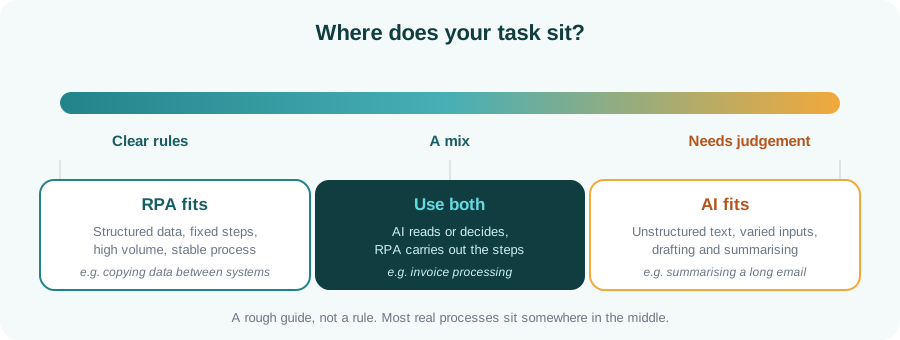
Where does your task sit?
Think of a spectrum. Tasks with clear rules sit at one end and suit RPA. Tasks that need judgement or deal with unstructured text sit at the other end and suit AI. Many real processes sit in the middle and benefit from both.
Questions to ask before you choose
- Can you write the steps down as clear rules?
- Is the information structured, such as fields in a system, or free text?
- How costly is a wrong result, and can someone check it easily?
- Do you need the same result every time, with a clear record of why?
They are partners, not rivals
In practice the strongest solutions combine them: AI interprets the messy input and RPA carries out the follow-up steps. Our article on AI and RPA together walks through an example.
Key takeaways
- RPA follows rules; AI learns patterns and handles ambiguity.
- Use RPA for predictable, structured work and AI for language and judgement.
- AI output needs checking; RPA rules need to be correct.
- Combining them often gives the best result.
Not sure which to learn?
Tell us your background and goals and we will suggest a path, or browse all courses.
Ask us which course suits you